# Day 01 Arrive at Delhi
On your arrival in Delhi, you will be transferred to your hotel. Delhi has been inhabited from the
6th century BC has been a capital of many kingdoms. It has been destroyed and rebuilt many times and is called
the "city of cities". Delhi's culture has been influenced by its different rulers and the city is full of
beautiful monuments. The Mughal rulers influenced the food habits of the residents and Mughlai cuisine
originated here. Due to the proximity of different states, all festivals are celebrated here. Old Delhi is a
maze of small lanes lined and old buildings and New Delhi has large road with huge buildings. Delhi is the
capital of India and is the hub for politics. Overnight at hotel.
# Day 02 Delhi
Today you have a full day tour of Delhi. Your morning tour starts with Old Delhi, built by the
Mughal emperor Shah Jahan in 1639 AD. You will visit the Raj Ghat where father of our nation Mahatma Gandhi was
cremated. You will be visiting the museum that was built to commemorate him. You will be driven past the iconic
Red Fort and Chandni Chowk, a very popular and a busy market in Old Delhi. Later we will move to the next stop -
Jama Masjid, one of the iconic, historic and largest mosques in India - built by Shah Jahan. A rickshaw ride
(optional) in Chandni Chowk could be quite interesting as this part of the city is quite crowded as it is full
of shops. These numerous shops sell delicious mouth-watering food, clothes, jewels, household goods, etc. and
are virtually a shopper's paradise.
In the afternoon, you will visit Qutub Minar, touted as India’s largest Minaret. Qutub Minar, a
UNESCO World Heritage Site, was built in 1192 by Turk ruler Qutub-Ud-Din Aibak. You will then move forward to
Humayun’s tomb, yet another UNESCO world heritage site. Your next stop is India Gate, built in memory of the
Unknown Soldier. You will be driven past the Parliament House, President’s House and other Government
Secretarial Buildings, to your final stop will be at Lakshminarayan Temple, a temple dedicated to Lakshmi and
Lord Narayana. Overnight at hotel.
# Day 03 Delhi - Jaipur
You will be transferred by road to Jaipur. Jaipur, the capital of Rajasthan gets its name from Maharaja Jai Singh who built this city. Many captivating palaces are present here having breathtaking design and architecture. In the 18th century Prince of Wales had visited Jaipur and the entire city was painted in pink color due to which this city is also known as the pink city. The origin of Jaipur goes back to more than 260 years.
On your arrival in Jaipur you will be transferred to your hotel.
In the afternoon tour of Jaipur you will be taken to Maharaja City Palace, a royal palace with seven storey as well as Jantar Mantar, the observatory. This wonderful observatory is attracted by mathematician as well as astronomers of whole world. City palace is perfect blend of all three excellent styles (Mughal, Rajput and European). Another palace, Hawa Mahal is popular all over world for it magnificent architecture. You will be taken through pink rose garden as well business centers of Jaipur. A tour of Jaipur is not complete without shopping. Jaipur is famous for clothes, carpets, precious and semi-precious stones and jewelry and various handicrafts made of wood, metals, etc. and also for silk paintings and miniatures.
# Day 04 Jaipur
Today you have a full day tour of Jaipur and Amer Fort. The morning journey starts from Amer fort also known as Amer Palace, the earlier capital of Jaipur. This magnificent fort was constructed in red sand-stone and marble by Raja Man Singh and is divided into four sections each with a courtyard. The main entrance gate is Surajpol having a fascinating architecture. Near the Ganesh Gate, there is a temple dedicated to the Goddess Sila Devi. The Diwan-e-Aam - Hall of public audience, Diwan-e-Khas - hall of private audience, Sheesh Mahal - palace of mirrors and Sukh Niwas are quite beautiful. At the he Sukh Niwas, a pleasant climate is created by winds that blow over a water cascade. #In Jaipur you will be taken to Maharaja City Palace, a royal palace with seven storey as well as Jantar Mantar, the observatory. This wonderful observatory is attracted by mathematician as well as astronomers of whole world. City palace is perfect blend of all three excellent styles (Mughal, Rajput and European).Drive past another palace, Hawa Mahal is popular all over world for it magnificent architecture. A tour of Jaipur is not complete without shopping. Jaipur is famous for clothes, carpets, precious and semi-precious stones and jewelry and various handicrafts made of wood, metals, etc. and also for silk paintings and miniatures.
# Day 05 Jaipur - Agra
You will be transferred by road to Agra visiting Fatehpur Sikri enroute. Fatehpur Sikri which was built in the 16th century by Emperor Akbar. Fatehpur Sikri holds exceptional testimony to Mughal civilization and is one of well-known UNESCO World heritage site of India and has various historical monuments. You will visit the Jama Masjid, followed by the Tomb of Salim Chishti, the five storied Panch Mahal and Buland Darwaza a graceful monument and stupendous piece of beautiful architectures. It is central portico with a total of three arched entrances and is locally known as Horseshoe gate. You will visit the other graceful buildings of this place such as Ibadat Khana, Mariam-uz-Zamani’s palace, Naubat Khana and Birbal’s house. #Agra the former capital of Hindustan is a city on the banks of the river Yamuna. Agra is a major tourist destination of India and a part of the Golden Triangle Tour along with Delhi and Jaipur. Agra also known as Akbarabad went through its peak during the time of Mughals and was the capital of under the Mughal rulers Akbar, Jahangir and Shahjehan.
On arrival in Agra you will be transferred to your hotel. Agra the former capital of Hindustan is a city on the banks of the river Yamuna. Agra is a major tourist destination of India and a part of the Golden Triangle Tour along with Delhi and Jaipur. Agra also known as Akbarabad went through its peak during the time of Mughals and was the capital of under the Mughal rulers Akbar, Jahangir and Shahjehan.
# Day 06 Agra
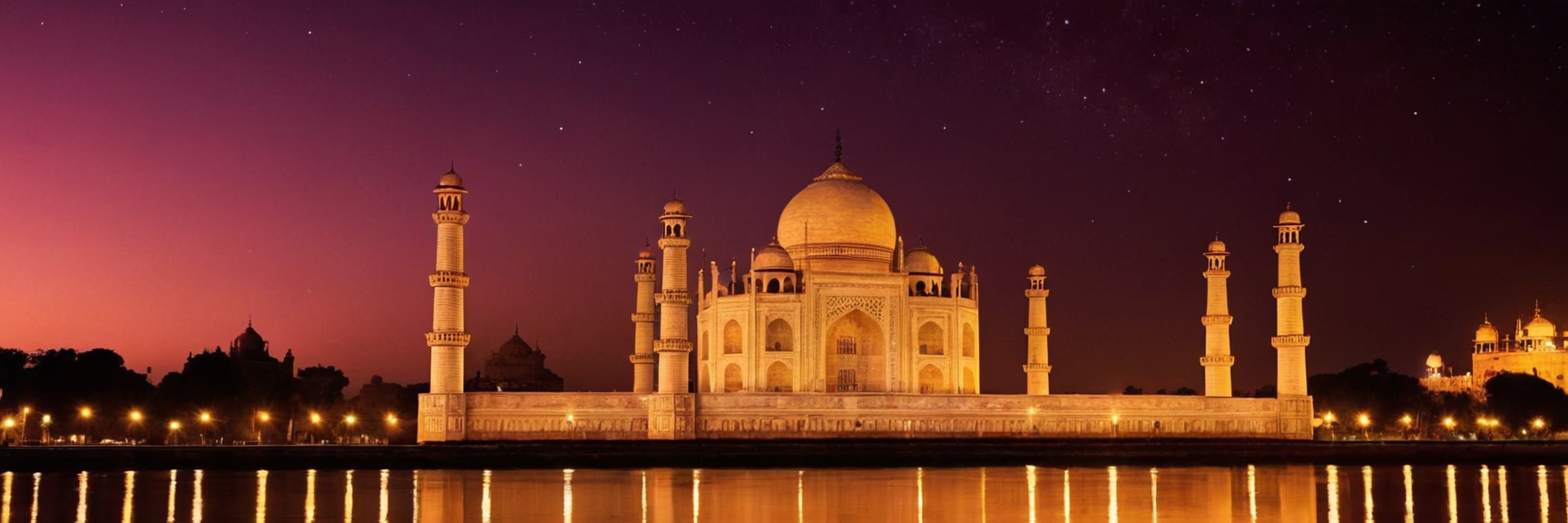
Today you will enjoy a full day tour of Agra and will be taken to Taj Mahal, one of the wonders of the world. This beautiful building is elegantly built with white marble by the Mughal Emperor Shah Jahan between the years 1631 to 1648 and it was built in the memory of his favorite beloved Queen Mumtaz Mahal. Standing majestically on banks of Yamuna River, this breathtaking, immensely beautiful monument is a synonymous to romance and love. #Your next stop Agra Fort is a UNESCO World Heritage Site and known for its architectural structure and was built in the 16th century during the Mughal Empire. This place comprises of several fairy-tale palaces like Khas Mahal and Jahangir Palace. Over here you will also get a chance to see Diwan-e-Aam and Diwan-e-Khas, which are also known as private audience hall and public audience hall. Agra is famous for inlaid marble work and handicrafts. TAJ MAHAL IS CLOSED ON FRIDAYS.
# Day 07 Agra - Gwalior
Arrive Gwalior and transfer to hotel. Gwalior, a historical town renowned for the sacred temples, outstanding palaces, as well as glorious monuments was founded by the King Surajesan. The legend is that Prince Suraj Sen lost his way in the jungle. On meeting a sage Gwalipa the Prince asked for water and was led water which quenched his thirst as well as cured him of leprosy. In return, the sage asked him to construct a wall to protect the sages from wild animals. The Prince obliged and named the place Gwalior after the sage. Gwalior is the birth-place of world class musician Tansen and every winter a huge cultural festival is organized in memory of Tansen, which attracts music lover from across the world.
In the afternoon Gwalior tour you will be taken to the Man Mandir from the 16th century, the Gujari Mahal which is now an archaeological museum, Teli Ka Mandir – a beautiful tall structure of about 100 feet, the 9th century Sas-bahu Temple that allures devotees to this place, Jai Vilas Palace – a European style palace of European type that now has been transformed into a museum, Mausoleum of the Tansen, Tomb of the Gaus Mohammad and of course the bazaars.
# Day 08 Gwalior - Orchha
You will be transferred by road to Orchha. Orchha was established in the 15th century AD by Rudra Pratap Singh, the first king of Orchha. The Orchha Fort was also built by the same king. Orchha Fort consists of several constructions like Raja Mahal, Jahangir Mahal, etc. Raj Mandir was built by 'Madhukar Shah' during 1554 to 1591 AD and the Chaturbhuj Temple was built by Queen Ganeshi Bai. You could climb the roof of the camel shelter "Uth Khana" for a beautiful view of Orchha. This is where the camels of the kings were held. The Orchha town has numerous temples and tombs and the fort has plenty of cenotaphs.
On your arrival in Jhansi you will be transferred to Orchha. Orchha was established in the 15th century AD by Rudra Pratap Singh, the first king of Orchha. The Orchha Fort was also built by the same king. Orchha Fort consists of several constructions like Raja Mahal, Jahangir Mahal, etc. Raj Mandir was built by 'Madhukar Shah' during 1554 to 1591 AD and the Chaturbhuj Temple was built by Queen Ganeshi Bai. You could climb the roof of the camel shelter "Uth Khana" for a beautiful view of Orchha. This is where the camels of the kings were held. The Orchha town has numerous temples and tombs and the fort has plenty of cenotaphs.
# Day 09 Orchha - Khajuraho
Orchha was founded in the 16th century by the Bundela Rajput chieftain, Rudra Pratap, who chose this stretch of land along the Betwa River as an ideal site for his capital. Of the succeeding rulers, the most notable was Raja Bir Singh Ju Deo who built the exquisite Jehangir Mahal, a tiered palace crowned by graceful chhatris. From here the view of soaring temple spires and cenotaphs is spectacular. Complementing the noble proportions of their exteriors are interiors which represent the finest flowering of the Bundela School of painting. In the Laxminarayan Temple and Raj Mahal, vibrant murals encompassing a variety of religious and secular themes, bring the walls and ceilings to rich life. Scattered around the area are the little shrines and memorials, each with its own poignant history, each contributing to the nostalgic beauty that is Orchha.
You will be transferred by road to Khajuraho. Khajuraho is known for its erotic and beautiful temples. These temples were constructed by the Chandelas during 950 AD to 1050 AD. After the period of Chandelas, these temples were forgotten and covered with dense palm-date trees. The name Khajuraho comes from the date trees known as Khajur trees in Hindi. In the year 1838, Capt. T.S. Burt and an engineer from British army re-discovered this place.
On your arrival in Khajurao you will be transferred to your hotel. Khajuraho is known for its erotic and beautiful temples. These temples were constructed by the Chandelas during 950 AD to 1050 AD. After the period of Chandelas, these temples were forgotten and covered with dense palm-date trees. The name Khajuraho comes from the date trees known as Khajur trees in Hindi. In the year 1838, Capt. T.S. Burt and an engineer from British army re-discovered this place.
# Day 10 Khajuraho
Your morning visit of Khajuraho will take you to the different temples. The Khajuraho sight-seeing will take you to temples like Chaunset Yogini Kali Temple, Bharatji or Chitragupta temple that is composed of magnificent 11 headed pictures of Lord Vishnu, Lakshmana Temple, Mahadev Temple, Nandi & Vishvanath Temples and Shiva Visha Temple. The Parasvanath Temple of Khajuraho is the only Jain temple that still exists. The Javeri Temple is dedicated to the Hindu Lord Vishnu. The other temples you can visit are dedicated to Lord Brahma, Lord Adinath and Yamuna.
# Day 11 Khajuraho - Allahabad
You will be transferred to Allahabad by road. Allahabad is known as Prayag or Prayaga or "place of offerings". This city is also known as Triveni or the union place of the three sacred rivers Ganges, Yamuna and the invisible Saraswati. Allahabad hosts the world’s largest religious gathering Maha Kumbh Mela once every twelve years and Ardh Kumbh Mela once every six years. Millions of Hindus visit this sacred city and take a bath at the meeting point of the rivers.
On arrival in Allahabad you will be transferred to your hotel. Allahabad is known as Prayag or Prayaga or "place of offerings". This city is also known as Triveni or the union place of the three sacred rivers Ganges, Yamuna and the invisible Saraswati. Allahabad hosts the world’s largest religious gathering Maha Kumbh Mela once every twelve years and Ardh Kumbh Mela once every six years. Millions of Hindus visit this sacred city and take a bath at the meeting point of the rivers.
# Day 12 Allahabad - Varanasi
This morning you will be visiting the Allahabad Fort. The original fort was built by built by Emperor Ashoka and was repaired by Emperor Akbar in 1583. Inside the fort is an Ashoka pillar with edicts inscribed on it. The Allahabad High Court is a good example of Georgian architecture and is one of the oldest courts of India. The Allahabad University is one of the oldest universities of India. Anand Bhavan is a large house which is now converted into a museum.
On your arrival in Varanasi you will be transferred to your hotel. Varanasi also called Benaras or Banaras or Kashi is said to be the oldest living city in the world, dating back to 5000 years. It has been the cultural and spiritual capital of North India for years. The belief of Hindus is that death in Varanasi leads to salvation. Varanasi is also known as the holy city of India or the city of temples, or the city of learning and also as the oldest living city on earth.
This evening you will be taken to the River Ganges for a boat ride. Two of most renowned ghats Manikarnika and Harishchandra are frequented by hundreds of devotees. These two ghats are quite famous not only for taking a holy dip, but also for cremation purposes. It is strongly believed by Hindus that whoever dies in Varanasi and gets cremated on bank of river Ganga achieves salvation, thereby releasing him form this birth cycle. You may witness numerous funeral pyres burning around in these ghats.
In the evening you will visit the ceremony of Aarti to the river Ganges, The great 'Aarti' to the Ghat of Dasaashwamedh is held every sunset by five priests dressed in white. These five young people choreographed movements apparently worship the river goddess with incense, camphor, flowers and mud lamps. Thousands of lighting lamps are immersed in the water of the sacred Ganges and the floating lamps add a divine aspect to the river.
# Day 13 - Varanasi
Morning city tour. Varanasi - Hindus holiest city and one of the oldest living cities in the world. Varanasi was already old when Rome was founded, a flourishing trade centre when the Buddha came to Sarnath to preach his first sermon. It was a city of great wealth and religious importance when the Chinese travelers Hiuen Tsang visited in the 7th century. Visit the Bharat Mata Temple with a big relief map of India in marble, Durga Temple,Tulsi Manas Mandir,Banaras Hindu University which has an Art Gallery and the Mosque of Moghul Emperor Aurangazeb built on the site of an ancient Hindu Temple.
Half day tour of Sarnath. Visit the buried Buddhist city where Lord Buddha gave his first sermon, Sarnath was a renowned school of learning from 6th century B.C. to 12th century AD. Visit the ruins, the stupa, the Buddhist temple and the Museum (Museum closed on Fridays).
# Day 14 Varanasi - Ayodhya
Ayodhya located on the right bank of the river Sarayu is the birthplace of Lord Rama. According to Ramayana, the city is 9,000 years old. Ayodhya is one of the seven most sacred cities of India for the Hindus. In this city, apart than Hinduism, several other religions like Buddhism, Jainism and Islam also has prospered. According to Jain Agamas it is the second eternal city after Shikharji. Five Tirthankaras were born here. The city is important for Buddhists as it had several Buddhist temples, monuments and centers of learning during the Mauryan Empire and Gupta Dynasty.
Early Morning Visit Ayodhya RAM MANDIR & other temples.
Visit Shri Ram Janmbhoomi Teerth Kshetra, The birthplace of Lord Rama, the 7th avatar of the Hindu deity Vishnu. The Ramayana states that the location of Rama's birthplace is on the banks of the Sarayu river in a city called "Ayodhya". The giant and gigantic temple, built over 5 years is a holy shrine for Hindus across the globe. #Then visit Kanak Bhawan , also known as Sone-ka-ghar, is widely known for images showing Lord Ram and Goddess Sita wearing gold crowns. Hanuman Garhi , a temple of Lord Hanuman in Ayodhya. More than 70 steps lead to the main Hanuman temple which is one of the most popular temples of Lord Hanuman in North India.#Afterwards, come to the Ghat of Saryu river and witness Aarti ceremony. Also visit Ganga Bhawan.
# Day 15 Ayodhya - Lucknow
You will be transferred by road to to Lucknow. On your arrival in Lucknow you will be transferred to your hotel. Lucknow "city of Nawabs" is known for its etiquette and sophistication and is also called the Golden City of India and Constantinople of the East and is known for its Imambaras, mosques, Islamic shrines, baradaris and gardens. This city was a major centre of Indian rebellion of 1857 and was active in India's Independence movement. Music and dance flourished under the Nawabs of Lucknow which was said to North India’s cultural capital. The Awadh has its own distinct style of cuisine and consists of biryanis, kebabs and breads and is the location of Kathak, Khayal, Nawabs and Classical music.
On your arrival in Lucknow you will be transferred to your hotel. Lucknow "city of Nawabs" is known for its etiquette and sophistication and is also called the Golden City of India and Constantinople of the East and is known for its Imambaras, mosques, Islamic shrines, baradaris and gardens. This city was a major centre of Indian rebellion of 1857 and was active in India's Independence movement. Music and dance flourished under the Nawabs of Lucknow which was said to North India’s cultural capital. The Awadh has its own distinct style of cuisine and consists of biryanis, kebabs and breads and is the location of Kathak, Khayal, Nawabs and Classical music.
This afternoon you will be visiting the Great Imambara, Jama Masjid and Picture gallery, the Clock Tower, Roomi Darwaza and Residency & Dilkusha Palace. A fusion of Mughlai and Turkish style of Architecture can be seen in the Bara Imambara, Chhota Imambara and other monuments.
# Day 16 Lucknow Delhi ( Flight )
You will be transferred to airport in time for your flight to Delhi.
On your arrival in Delhi you will be transferred to your hotel.
# Day 17 Delhi
Intime transfer to Delhi airport.